Photo: Sean Nufer on Unsplash
Before you sign a 12-month lease, you'll probably want to know what's been happening on the blocks around the building. Good news: in Houston you don't have to guess. Most of the data is public, and you can check any address in about 10 minutes.
This guide covers the tools we point every client to, what Houston's latest numbers actually show, and the questions to ask on a tour.
The short answer: is Houston crime going up or down?
Down, by a lot. Houston Police Department figures show:
- 2025 vs 2024: Violent crime fell 18.9%. Murders were down 19%, robberies down 22.6% and aggravated assaults down 17.6% (HPD's 2025 year-end update, reported by Houston Public Media).
- First half of 2026 vs first half of 2025: We pulled HPD's public incident data for January through June. Reported offenses fell about 18% overall:
| Offense (Jan–Jun) | 2025 | 2026 | Change |
|---|---|---|---|
| Murder | 152 | 95 | −37.5% |
| Robbery | 2,671 | 1,949 | −27.0% |
| Aggravated assault | 7,970 | 6,577 | −17.5% |
| Burglary (break-ins) | 5,939 | 4,655 | −21.6% |
| Car break-ins | 13,224 | 9,489 | −28.2% |
| Car theft | 6,876 | 5,693 | −17.2% |
| Vandalism | 10,710 | 6,985 | −34.8% |
The Major Cities Chiefs Association's mid-year report shows the same trend: homicides in Houston were down 38%, compared with 17% across the big U.S. cities it tracks.
Citywide numbers only tell you so much, though. Houston covers more than 600 square miles. What matters for you is the few blocks around one building, and that's what the tools below are for.
Tool 1: SpotCrime (the fastest way to see a map)
SpotCrime is the tool we've recommended to clients for years. It's an independent crime map that takes police reports and verified news reports and pins them on a Google map.
How to use it:
- Go to spotcrime.com and type in the building's address.
- Look at the pins within about half a mile. Each one shows the type of incident (theft, burglary, robbery, assault, vandalism, shooting and so on), plus the date and the block.
- Create an account. Without one, SpotCrime only shows 5 recent incidents. With an account you see the full map and trends.
- Set up an email alert for the address (spotcrime.com/alerts/new). You'll get daily or weekly updates while you're deciding, and you can keep it after you move in.
What to look for: patterns, not single pins. One car break-in last month tells you very little. A cluster of car break-ins in the same parking lot every week tells you a lot.
Tool 2: HPD's official crime data by beat (the source)
SpotCrime is quick. The Houston Police Department's own data is the original source, and it's more detailed.
HPD publishes every report it writes, by police beat and street block, at Monthly Crime Data by Street and Police Beat. The data is updated monthly, usually 1–2 weeks after the month ends.
How to use it:
- On that page, click the area of Houston you're looking at on the map, then pick the beat (each beat page lists its street boundaries, landmarks and ZIP codes).
- Choose a month. You'll get a table of every reported offense in that beat: the type, date and time, the block and street, and the premise type.
- The premise column is the gold. It tells you whether an incident happened at a home or apartment, in a parking lot or garage, on the street, or at a store. If you see a run of car break-ins listed at "Parking Lot, Garage" on the building's own block, ask the leasing office about it.
For privacy, HPD shows the hundred block, never the exact address.
One caution from HPD itself: the department says it does not recommend comparing areas using raw counts. A beat with a mall, a stadium or a busy nightlife strip will show more reports simply because more people pass through it. Compare the same area over time, and look at the types of incidents, not just the total.
Outside Houston city limits? Use the county or the city's own police
A "Houston" mailing address isn't always in the City of Houston. Katy, Cypress, Spring, Humble and much of the area around them are served by other agencies, so HPD's data won't cover them.
- Unincorporated Harris County: the Harris County Sheriff's Office online portal lets you search public safety incidents.
- Suburban cities (Sugar Land, Pearland, Katy, League City and others) have their own police departments. Search "[city name] police crime map" or call the department's non-emergency line.
- Any U.S. agency: the FBI's Crime Data Explorer has yearly totals reported by each police department.
Tool 3: The Texas public sex offender registry
The Texas Department of Public Safety keeps a public registry you can search by address, ZIP code or name, with a map view: sor.dps.texas.gov. Many parents check it next to schools. Read the notes on the DPS site before drawing conclusions from a result.
What Houston's crime data tells renters
We went through HPD's 2025 incident data (about 248,000 reported offenses) looking for the patterns that matter when you're picking an apartment.
1. Your car is the biggest target. Car break-ins (theft from a vehicle) were the second most reported offense in Houston in 2025: 24,011 reports. Add 12,902 stolen cars and 8,122 thefts of car parts, like catalytic converters.
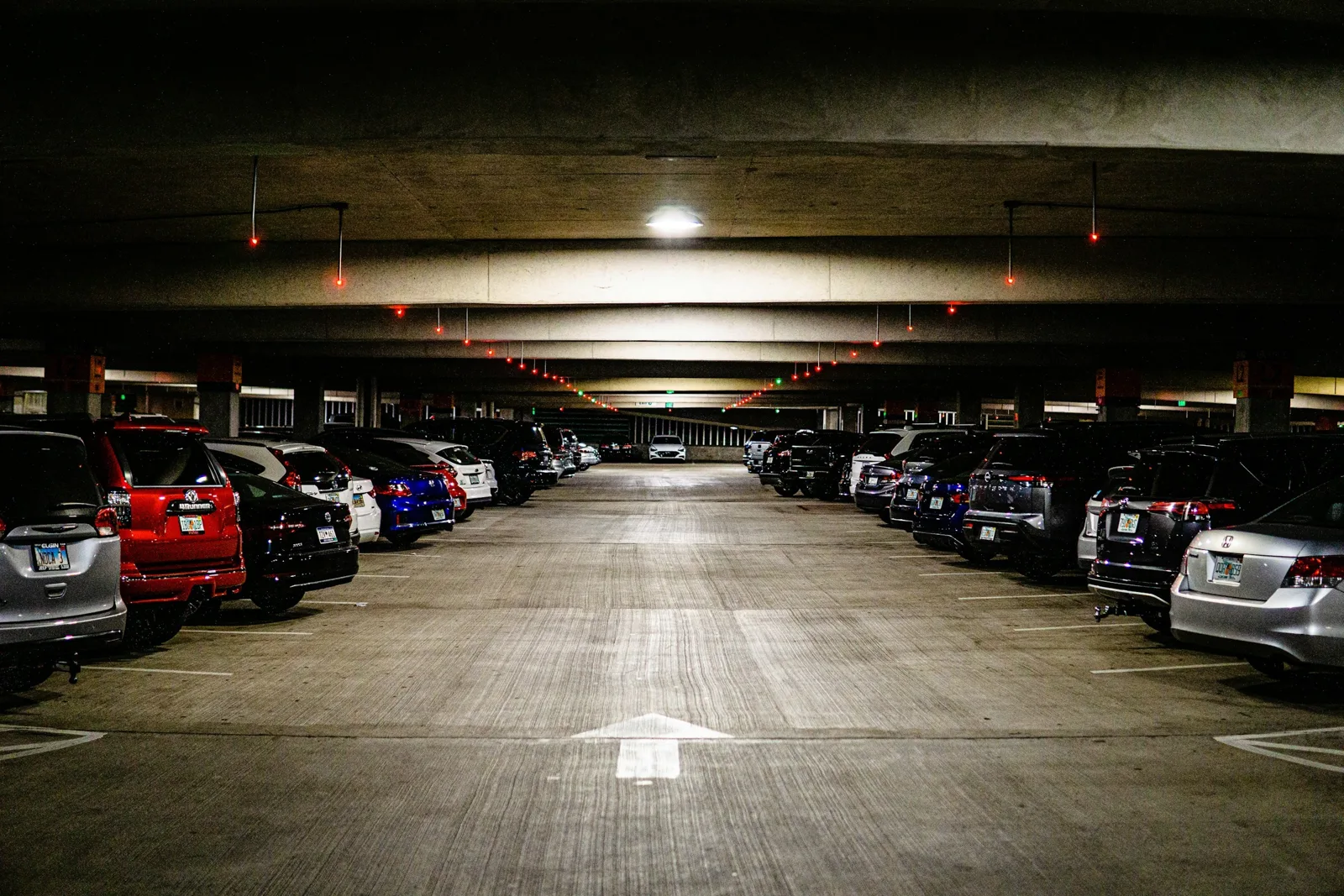
2. Most of it happens in parking lots, after dark. More than half of car break-ins (53%) were reported in a parking lot or garage. About 4 in 10 happened between 6 pm and midnight, with the peak around 7 pm.
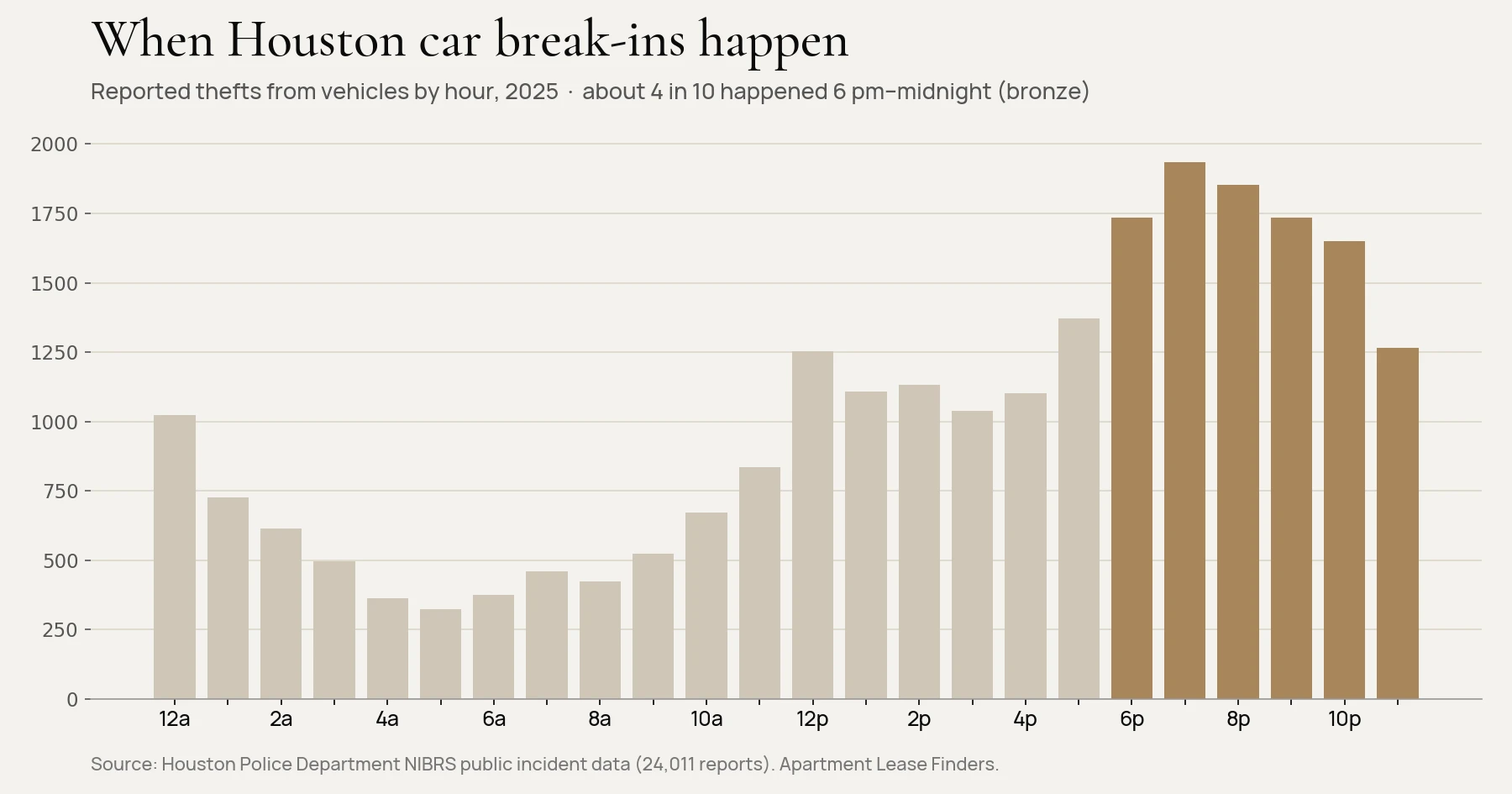
Car break-ins in Houston by hour, 2025. Source: Houston Police Department NIBRS public data.
What that means for you: parking is a real safety question, not just a convenience one. On a tour, ask whether the garage is gated or controlled access, whether it has cameras and good lighting, and whether you get an assigned space. And keep valuables, bags and anything that looks like a bag out of sight. Houston police say many of these are crimes of opportunity.
3. Break-ins aren't only a night thing. About 42% of burglaries were reported between 8 am and 6 pm, when most people are at work. Good locks and a door that actually latches matter around the clock.
4. Watch for scams, too. HPD took roughly 2,860 identity theft reports and 2,450 fraud ("false pretenses") reports in 2025. For renters, that includes fake listings that ask for a deposit before you've seen the unit. Never wire money or pay with a gift card to hold an apartment, and always confirm you're dealing with the real leasing office.
Your rights: locks every Texas apartment must have
Texas law gives every renter specific security rights, and your lease can't waive them (Texas Property Code, Chapter 92, Subchapter D):
- Required at the landlord's expense: a window latch on every exterior window; a keyed deadbolt or doorknob lock on each exterior door; a keyless bolting device (like a night latch) and a door viewer (peephole) on each exterior door; and a pin lock plus a handle latch or security bar on every sliding glass door (§92.153).
- Rekeyed for you: the landlord must rekey the locks at its own cost no later than 7 days after each tenant turnover (§92.156). You can also ask for more rekeying at your own expense, as often as you want.
On move-in day, check that every one of these is there and works. If something is missing, put your request in writing.
Your tour checklist
Bring this list on every tour. It works for any building:
- Search the address on SpotCrime and set up an alert.
- Pull the last 3–6 months for the building's HPD beat and check the premise types.
- Visit at least once in the evening. A daytime tour doesn't show you what the parking lot, lighting and entry gates are like at night.
- Ask the leasing office:
- Is the parking garage gated or controlled access? Are there cameras?
- How do residents and guests get in (fobs, codes, front desk)?
- Are there package lockers or a package room?
- Have there been break-ins or car break-ins on the property recently, and what changed?
- When were the locks on this unit last rekeyed?
- Walk the route from your parking space to your door, and from your door to the trash and mail areas.
- On move-in day, check every lock, latch and peephole on the list above.
Looking for the "safest neighborhoods in Houston"?
You'll find plenty of online lists. We don't publish one, on purpose. Those lists use different data, different time frames and different boundaries, so they often disagree with each other. And a single label can't tell you about the block, the building or the parking garage you'd actually be living in.
The tools above can. Pull the data for each building you're considering, compare the same kinds of incidents, and decide what matters to you.
Let us do the legwork
Send us your shortlist or the areas you're considering, and we'll pull every building that fits your budget, move date and must-haves, gated parking and controlled access included. We give every client the same research tools in this guide, so you can check each address yourself before you sign. We do in one conversation what takes most renters weeks on their own, and the properties pay us, so it costs you nothing.
DM us "TOUR" or call (713) 357-6339, or start your search.
Crime figures from the Houston Police Department (NIBRS public incident data for 2025 and January–June 2026, downloaded November 2026, and HPD's 2025 year-end update as reported by Houston Public Media), and the Major Cities Chiefs Association 2026 mid-year report. Figures are reported offenses, not convictions, and many crimes go unreported. Data is revised over time. Tool features from SpotCrime, Harris County Sheriff's Office, the FBI and the Texas Department of Public Safety, checked November 2026. Security device rules from Texas Property Code §§92.153 and 92.156; this is general information, not legal advice. Apartment Lease Finders does not rate the safety of any neighborhood or property.